The Factory
kj stage draws your project as a factory seen from above. Each workshop is a line of work, each robot is an agent or a piece of the Karajan method, and nothing moves without a real event: a commit, a review verdict, a command the Sentinel stopped. When it opens, every piece shows its last real state; from then on it plays what happens.
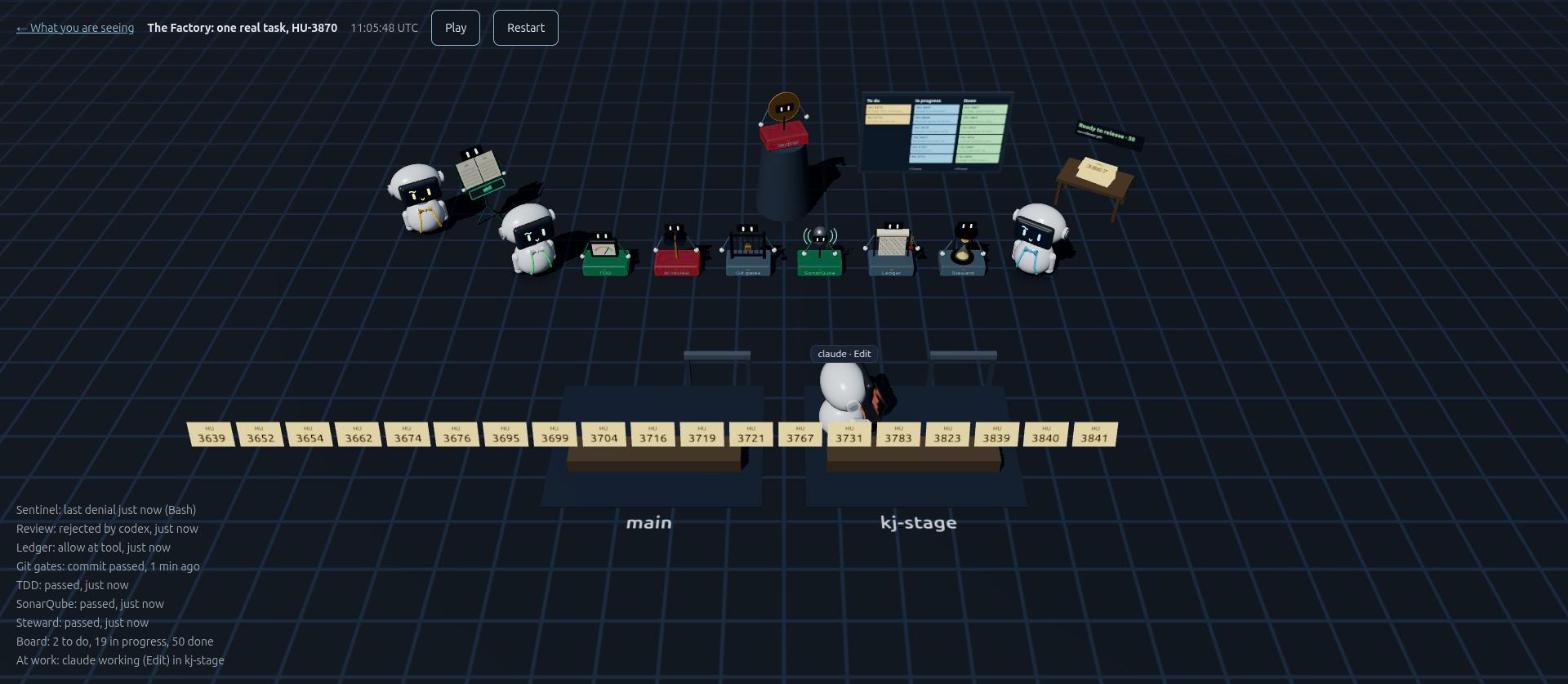
One real task: HU-3870
The replay is not a mock-up. It is the trace kj wrote while Claude Code built HU-3870 of Karajan Code itself, on 11 November 2026, from 10:53 to 11:24 UTC. Waits longer than 2.5 seconds are shortened, so half an hour plays in under two minutes; the clock shows the real time of each event.
- The card is added and the agent starts editing in the
kj-stageworkshop. - The Sentinel stops two shell commands it cannot verify.
- TDD, SonarQube and the Steward check the diff, then codex rejects it. The agent fixes it and codex rejects it again.
- On the third review codex approves; the commit gate lets the commit through and the ledger seals it.
What each piece is
Workshops
One per lane: the main checkout and each worktree an agent works in. Each has a floor with the lane's name and a bench. New worktrees appear as they are created. The host agent sits at its bench, opens a laptop and types; its subagents walk out of it as small robots and back when they finish.
The Sentinel
It stands on a raised post and turns to the lane whose agent just started a tool call. When it denies one, it goes down to that agent, stays a moment and climbs back. The status list names the tool it stopped, never the command itself.
Git gates and the ledger
Each workshop has gates at its back corner. A commit that passes the hooks lights them green; a refused one lights them red with the rule that refused it. The ledger seals each decision in a hash chain and walks to the lane to do it.
Cross-AI review
Every diff is reviewed by a different AI before it is committed. When the review starts, the review piece walks to the lane with the reviewer's name; the verdict shows over the workshop, green when approved and red when rejected. Karajan, the conductor, waves its baton when the work passes and raises a hand to stop it when it fails.
TDD, SonarQube and the Steward
Before the review, kj checks the tests, the static analysis and the project's guarantees. Each check flashes its piece and sends it to the workshop it is checking.
The task wall
Three columns, To do, In progress and Done, with the cards of the project's HU Board. Next to it, the release table piles the cards done since the last git tag.
The courier
An errand robot, not an agent. When a card starts, it fetches it from the wall to the bench, where it stays as a note while the work goes on; when the card is done, it carries it back.
atril and kaRAGan
atril, the music stand, turns a page for each skill an agent starts with. kaRAGan brings the answer of the project's RAG to the agent that asked, and types at the lane while the index is rebuilt.
The map of factories
kj stageshows one project; adding?map=1to its address shows a factory for every project on your machine, the busy ones first, each with the cards in progress and the handoffs waiting for you.
See your own factory
kj stageIt opens the HU Board's stage page in your browser. Everything runs on your machine: the board listens on localhost, the scene reads the files kj writes in .karajan/, and nothing is sent anywhere. If you asked your system for reduced motion, the factory shows the lights and the status list without animating.